

What Is Screen Printing? A Complete Guide for Custom Apparel
Last Updated: 07/23/2026
Talk to our team today! (323) 261-8700

Key Takeaways
- Screen printing pushes ink through a stencil on mesh — one screen per color.
- Best for bulk orders (12+), bold solid colors, and long-wear durability.
- Setup is per-color and front-loaded; the per-shirt price drops sharply at higher quantities.
- DTLA: screen printing from 12 pieces, Pantone-matched inks, 10–14 day turnaround (rush 3–5).
Screen printing is a decoration method that pushes ink through a mesh stencil — one screen per color — directly onto fabric, producing bold, durable prints that last as long as the garment itself. It’s the go-to technique for team uniforms, branded merch, event tees, and any order where color accuracy and longevity matter more than per-unit cost.
If you’ve ever wondered why custom t-shirts from a concert or a corporate event still look sharp after 50 washes, screen printing is why. This guide breaks down exactly how the process works, when to choose it over alternatives like DTG or embroidery, and how to order at DTLA Print — right here in downtown Los Angeles.

How Screen Printing Works
Screen printing follows a straightforward four-step process: coat, expose, print, cure.
Step 1 — The Stencil (Screen)
A mesh screen (typically polyester) is coated with a light-sensitive emulsion. Your artwork is printed onto a transparent film and laid over the screen. When exposed to UV light, the emulsion hardens everywhere except where the artwork blocks it. Wash away the unexposed emulsion and you have a precise stencil — ink can only pass through where your design lives.
Step 2 — One Screen Per Color
Each color in your design requires its own screen. A two-color logo needs two screens; a full-color gradient needs more. This is why screen printing shines on simple, high-contrast designs — and why setup costs are front-loaded rather than per-unit.
Step 3 — The Squeegee Pull
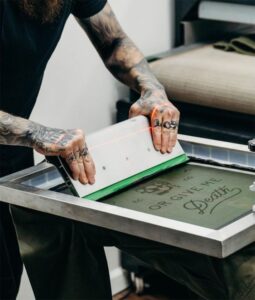
The garment is laid flat on a platen beneath the screen. Ink is placed at the top of the screen and a squeegee drags it across, forcing ink through the open mesh onto the fabric below. Each color is applied in sequence, with registration marks ensuring every layer aligns perfectly.
Step 4 — Cure
Printed garments pass through a conveyor dryer at 320°F. The heat bonds the ink to the fabric fibers, creating a wash-fast, scratch-resistant finish. Proper curing is what separates a print that lasts a decade from one that cracks after three washes.
Screen Printing vs. DTG vs. Embroidery
Choosing the right decoration method depends on your quantity, design complexity, fabric, and budget. Here’s how the three main options compare:
| Factor | Screen Printing | DTG (Direct-to-Garment) | Embroidery |
|---|---|---|---|
| Minimum quantity | 12 pieces at DTLA | 1 piece | 1 piece |
| Best for | Bulk orders, bold colors | Full-color photos, low qty | Polos, hats, structured items |
| Color accuracy | Pantone-matched, spot-on | CMYK process — good, not exact | Thread color, very durable |
| Durability | Excellent — decades | Good — fades with washing | Excellent — outlasts the garment |
| Setup cost | Screen fees per color | None | Digitizing fee (one-time) |
| Per-unit cost at volume | Lowest | Higher | Moderate–High |
| Fabric types | Cotton, blends, most tees | 100% cotton best | Most fabrics |
At DTLA Print, custom t-shirts ordered in bulk almost always land in screen printing territory — the per-unit cost drops sharply and the print quality is unmatched for solid-color logos and text-heavy designs.
When Screen Printing Is the Right Choice
- Bulk orders (12+ pieces): Setup costs are amortized across the run; the per-shirt price drops dramatically at 24, 48, and 72 pieces.
- Bold, solid colors: Plastisol and water-based inks pop on dark and light fabrics alike — no CMYK dot pattern, just pure pigment.
- Brand color accuracy: Pantone-matched inks mean your navy is exactly your navy, not an approximation. Critical for corporate merch and licensed work.
- Long-wear durability: Staff uniforms, workwear, and merch that needs to survive daily laundering belong in screen printing.
- Simple logo designs: 1–4 color logos, text, and geometric shapes are where screen printing is fastest and cheapest.
For bulk custom t-shirts, screen printing is almost always the most cost-effective path once you’re past the 12-piece threshold.

Screen Printing Ink Types
Plastisol Ink
The industry standard. Plastisol is PVC-based, opaque, and sits on top of the fabric with a slightly raised feel. It’s forgiving to print, cures predictably, and produces vivid colors on both light and dark garments. Most commercial screen prints you’ve worn are plastisol.
Water-Based Ink
Water-based inks absorb into the fabric rather than sitting on top, producing a softer hand-feel — the ink becomes part of the shirt. Preferred for fashion apparel, blanks where the fabric texture should show through, and eco-conscious brands. Slightly more demanding to cure correctly, but the result is a print that feels like it was woven in.
Pantone Color Matching
Both ink types can be mixed to hit a specific Pantone reference. At DTLA Print, we match inks to your Pantone swatches, so your brand colors are consistent across every run — every year. Learn more about Pantone color matching for screen printing and why it matters for brand consistency.
Specialty Inks
Beyond standard colors: metallic inks add a foil-like shimmer; puff additives expand during curing for a raised 3D effect; discharge inks bleach the dye from the fabric and replace it with pigment for an ultra-soft vintage feel on dyed garments.
Artwork Setup for Screen Printing
Screen printing works best with vector artwork (AI, EPS, or SVG). Each color in your design needs to be separated into its own layer. Key setup considerations:
- Color count: Fewer colors = lower setup cost. 1-color and 2-color prints are the most economical.
- Halftones: Gradients and photographic images are simulated with halftone dots — a pattern of same-color dots at varying densities. Works best when artwork is designed with this in mind.
- Underbase: Printing on dark garments usually requires a white underbase layer to make colors pop. This counts as an additional screen.
- Resolution: Raster files should be 300 DPI at print size. Lower resolution means jagged edges on fine lines.
At DTLA Print, every order includes free artwork touch-ups, digital mockups, and a proof for your approval before any screens are burned. You’ll see exactly what your shirts look like before we print a single one.

How to Order Screen Printing at DTLA Print
DTLA Print is an in-house decoration shop in downtown Los Angeles. Here’s how the process works from quote to delivery:
- Request a quote: Tell us your blank, quantity, print locations, and color count. Request a quote here — we typically respond same day.
- Send your artwork: Drop your vector file. If your file needs cleanup, we’ll handle it at no charge.
- Approve your mockup: We send a digital proof showing your design on the blank. Nothing prints until you approve it.
- Production: Standard turnaround is 10–14 business days from artwork approval. Rush production from 3–5 business days is available.
- Pickup or ship: Pick up in downtown LA or we’ll ship to you.
Minimum for screen printing is 12 pieces. DTG and embroidery are available from 1 piece if you need smaller quantities.
Frequently Asked Questions
What is the minimum order for screen printing?
At DTLA Print, screen printing starts at 12 pieces. For smaller quantities — even a single piece — we offer DTG printing, which requires no setup screens and works well for photographic or full-color artwork.
How long does screen printing last?
A properly cured screen print can outlast the garment itself. Plastisol prints regularly survive 50–100+ washes without cracking or fading when cared for correctly (inside-out, cold water, no high-heat drying). Water-based prints soften further over time but maintain color well.
Can screen printing match my exact brand color?
Yes. DTLA Print mixes inks to Pantone references, so your color is accurate every run. Provide your Pantone coated (C) or uncoated (U) swatch at the time of your order. Learn more about Pantone matching for screen prints.
What file format do I need for screen printing artwork?
Vector files (AI, EPS, PDF with outlined fonts, or SVG) are ideal. High-resolution PNG or PSD at 300 DPI at print size also works. If you only have a low-resolution logo, share what you have — our team will assess it and advise on next steps at no charge.
How is screen printing different from heat transfer?
Screen printing pushes ink directly through a stencil onto the fabric; heat transfer applies a pre-printed film to the surface using heat and pressure. Screen prints are more durable and cost-effective at volume. Heat transfers are faster for very small runs or individual names/numbers but don’t have the same longevity or premium feel.
Related at DTLA Print
Custom T-ShirtsBulk Custom T-ShirtsPantone Color MatchingGet a Quote
Let’s Get Started on your First Order

subcategories


Popular Products

Southern Tide Mini Skipjack Hat
Adidas Adjustable Washed Slouch Cap
Swannies - Delta Cap
Imperial - The Original Small Fit Performance Cap
Oakley - Pro-Formance Cap New
Sportsman - Five-Panel Rope Heritage Fit Cap
OTTO - 5 Panel Mid Profile Baseball Cap
AS Colour - STELLA LONGSLEEVE
AS Colour - Mens Raglan Tee
AS Colour - Mens State Tee
AS Colour - Youth L/S Tee
AS Colour - Mens Classic Pocket L/S Tee
AS Colour - Mens Heavy Tee
Los Angeles Apparel - 18/1 S/S Oversized Mock
Helly Hansen Mens Engram Jacket
Helly Hansen Mens Chelsea Evo Winter Jacket
Helly Hansen Mens Bergholm Insulated Winter Jacket
Helly Hansen Womens Salt Original Jacket
Helly Hansen Womens Imperial Pile Jacket
Helly Hansen Mens Daybreaker Block Microfleece Jacket
Helly Hansen Womens Aspire Puffy Parka
Los Angeles Apparel - 16oz. Plush Fleece PO Hoodie
Los Angeles Apparel - Baby Rib Long Sleeve Hoodie
Los Angeles Apparel - 12oz Fleece Wide Hoodie
Los Angeles Apparel - 12OZ TRIBLEND FLEECE HOODIE
Under Armour Womens Drive Pro Hybrid Hoodie
Under Armour Womens Breezy Hoodie
Southern Tide Womens Linley Brrr-illiant Performance Hoodie
AS Colour - Carrie Tote
Los Angeles Apparel - Bull Denim Shopping Bag
Peter Millar Pursuit Tote
Johnnie-O Dyed Canvas Tote Bag
Johnnie-O Nylon Packable Tote
Los Angeles Apparel - Oversize Bull Denim Bag
Patagonia Terravia Tote Pack
Everybody World - Adjustable Apron
Artisan Collection by Reprime - Annex Oxford Apron with Pocket
Artisan Collection by Reprime - Recycled Bib Apron
Artisan Collection by Reprime - Artisans Choice Canvas Apron
Artisan Collection by Reprime - Four-Pocket Jeans Stitch Denim Bib Apron
Artisan Collection by Reprime - Cross Back Barista Apron with Pocket
Artisan Collection by Reprime - Calibre Cotton Canvas Bib Apron
resources
get a quote!
Fill out this form to help us understand your needs and respond accurately.
4
47 Brand
A
Adams Headwear
A
Adidas
A
Allmade
A
American Apparel
A
ANETIK
A
Artisan Collection by Reprime
A
AS Colour
A
Atlantis Headwear
A
Augusta Sportswear
A
Authentic Pigment
B
Badger
B
BAGedge
B
Bayside
B
Beimar
B
Bella + Canvas
B
Bogg
B
Boxercraft
C
Carhartt
C
Carmel Towel Company
C
Champion
C
Colortone
C
CORE365
C
Columbia
C
Comfort Colors
C
Cotton Heritage
D
DTLA Print
D
Dyenomite
E
Econscious
E
Everybody World
E
Everywhere Apparel
F
Flexfit
F
Fruit of the Loom
G
G Fore
G
Galvin Green
G
Gildan
H
Hanes
H
Helly Hansen
I
Independent Trading Co.
I
Imperial
I
Infinity Her
J
Jaanuu
J
Jerzees
J
Johnnie-O
J
Just Hoods By AWDis
K
Kati
K
Kishigo
K
Knack
L
Lane Seven
L
Legacy
L
Liberty Bags
L
Linksoul
L
Los Angeles Apparel
M
M&O
M
Marine Layer
M
Mega Cap
N
New Era
N
Next Level
N
Nike
N
North Face
O
Oakley
O
OGIO
O
OGIO Endurance
O
Onna
O
OTTO
O
Original Favorites
P
Paragon
P
Patagonia
P
Peter Millar
P
Port & Company
P
Port Authority
Q
Q-Tees